Shaping High-Stakes Decision Environments
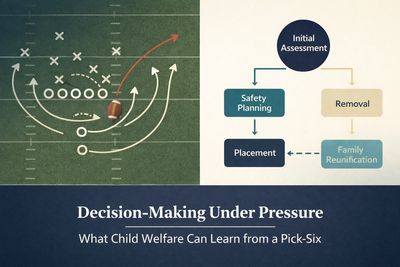
Child welfare leadership is not a theoretical exercise. It is a high-stakes decision environment shaped by pressure, ambiguity, public scrutiny, and human complexity.
Dr. Channing L. Collins delivers research-informed keynote presentations and executive trainings that help leaders strengthen judgment, reduce bias, improve accountability, and prepare systems before crisis occurs.
Her work bridges scholarship, frontline realities, and implementation strategy—equipping agencies to make better decisions under pressure.
Research-informed leadership conversations that strengthen child & family systems under pressure.
1. Implicit Bias in High-Stakes Decision Making
Beyond Awareness: How Bias Quietly Shapes Risk, Removal, and Accountability
Focus:
• How vague statutory language, including “imminent risk,” creates space for bias
• Media framing and narrative influence
• How quiet bias enters professional judgment without being recognized
• Organizational guardrails to reduce bias at the point of decision
Interactive elements:
• Quiet bias case scenarios
• Evidence vs. assumption exercises
• Language and framing comparisons
• Real-time decision exercises examining how identical facts can produce different interpretations
2. Football Pick-Six & Child Welfare
What High-Performance Teams Teach Us About Decision-Making Under Pressure
Child welfare decisions happen under:
• Time pressure
• Public scrutiny
• Incomplete information
• High consequences
A Pick-Six happens because:
• Anticipation
• Preparation
• Pattern recognition
• Team alignment
• Situational awareness
Interactive elements:
• “Film breakdown” style case review
• Decision clock exercises
• Crisis vs. preparation mapping
• After-action review model for agencies
3. Risk-Based Case Prioritization
From Overload to Intentional Decision Architecture
Focus:
• Distinguishing urgency from actual risk
• Prioritizing cases when workloads and competing demands are high
• Matching oversight and resources to potential consequence
• Creating decision structures that reduce reactive case management
Interactive elements:
• Case triage simulations
• Competing-priority exercises
• Risk, urgency, and consequence mapping
• “What gets attention first?” decision challenges
4. Balancing Prevention & Protection
Ending the False Tradeoff Narrative
Focus:
• Moving beyond the assumption that prevention and protection are competing goals
• Distinguishing situations requiring separation from those requiring support
• Examining the consequences of both under-intervention and over-intervention
• Matching the level of system response to the circumstances actually present
Interactive elements:
• Prevention vs. protection case scenarios
• Safety threat and protective capacity exercises
• Intervention continuum mapping
• “What happens if we act—or do not act?” decision exercises
5. Mediation at Critical Decision Points
De-escalation as a System Strategy
Focus:
• Identifying points where conflict begins driving system decisions
• Using mediation to improve communication among families, professionals, and systems
• Distinguishing positions from underlying interests
• Using de-escalation as a strategic systems tool rather than simply a response to conflict
Interactive elements:
• Critical decision-point simulations
• Position vs. interest mapping
• De-escalation exercises
• Multi-party conflict scenarios
6. Studying the Tape: Leadership Lessons from Failure
What High-Performance Systems Do After Things Go Wrong
Focus:
• The difference between accountability and blame
• How leadership response shapes system performance
• Why fear-based cultures weaken decision-making
• Building learning systems instead of reactive systems
Interactive elements:
• “Film review” critical incident breakdowns
• Blame vs. learning response mapping
• System failure vs. individual failure exercises
• After-action leadership analysis
7. Equity, Narrative, and Decision Integrity
How Bias and Storytelling Shape System Outcomes
Focus:
• Racial bias at the point of decision-making
• Media framing and its influence on perception and policy
• The gap between intent and impact in equity work
• Embedding equity into real-time decisions
Interactive elements:
• Competing-narrative case exercises
• Language and perception analysis
• Intent vs. impact scenarios
• Decision-integrity exercises examining where equity can be lost between policy and practice
8. Applying ICWA Principles to Broader Child Welfare Practice
What Strong Family Preservation Models Teach Us
Focus:
• Active efforts vs. reasonable efforts
• Family preservation as a system default
• Community-centered decision-making
• Translating ICWA-aligned practices across systems
Interactive elements:
• Active efforts vs. reasonable efforts case comparisons
• Family preservation decision exercises
• Community-resource mapping
• Practice scenarios exploring how ICWA-aligned principles can inform broader system design
9. Media Framing & the Child Welfare Narrative
How Language Shapes Public Perception, Policy, and System Response
Focus:
• How language changes the way identical facts are perceived
• The influence of media framing on public understanding of child welfare cases
• How race, gender, class, and family structure can shape dominant narratives
• The relationship between public narrative, institutional pressure, and system response
• Lessons from research on media portrayals and narrative construction
Interactive elements:
• Side-by-side framing exercises using the same underlying facts
• Headline and language analysis
• “What changed?” perception exercises
• Reframing cases without changing the evidence
10. Media Narratives in the Courtroom
When Public Narratives and Legal Decision-Making Collide
Focus:
• How preexisting narratives can shape perceptions of credibility, culpability, and risk
• The distinction between evidence and narrative
• Media exposure and the environment surrounding high-profile cases
• Recognizing framing and implicit assumptions within legal decision-making
• Protecting decision integrity when public pressure is high
Interactive elements:
• Evidence vs. narrative exercises
• Competing case-framing analysis
• Credibility and language exercises
• Judicial decision scenarios involving public and media pressure
11. The Collins Imminent Harm Standard
Creating a Clearer Threshold for Family Separation
Focus:
• Distinguishing risk from imminent harm
• Examining whether the identified danger requires immediate separation
• Reducing unnecessary removal while preserving protective authority
• Strengthening the articulation of evidence supporting removal decisions
• Creating greater consistency across agency and judicial decision-making
Interactive elements:
• Imminent-harm threshold exercises
• Case scenarios with competing interpretations of risk
• Removal/no-removal decision exercises
• Evidence vs. assumption mapping
12. The CIHS Dual-Threshold Model
Intervention Does Not Automatically Mean Removal
Focus:
• Separating the threshold for system intervention from the threshold for family separation
• Recognizing circumstances requiring agency involvement without requiring removal
• Matching the level of intervention to the level of danger
• Examining less intrusive protective responses
• Strengthening proportionality in child welfare decision-making
Interactive elements:
• Dual-threshold case exercises
• Intervention vs. removal mapping
• Escalation and de-escalation scenarios
• Cross-disciplinary decision comparison
13. Before the Decision: Mediation in Child Welfare
What Changes When We Resolve Conflict Before Positions Harden?
Focus:
• Moving mediation upstream in the child welfare process
• Using structured dialogue before decisions become adversarial positions
• Elevating family and professional voices at critical decision points
• Identifying areas of agreement before conflict escalates
• Understanding when mediation is—and is not—appropriate
Interactive elements:
• Pre-decision mediation simulations
• Competing-position exercises
• Interest vs. position mapping
• Facilitated resolution scenarios
14. Child Welfare in the Courtroom
The Intersection of Professional Judgment, Evidence, and Judicial Decision-Making
Focus:
• How frontline assessments become evidence presented to the court
• Distinguishing professional judgment, factual evidence, inference, and narrative
• How agency and judicial decision-making interact at critical points in a case
• Strengthening the articulation of safety concerns and intervention decisions
• Examining how different professionals can reasonably interpret the same information
Interactive elements:
• Courtroom decision scenarios
• Evidence vs. professional judgment exercises
• Case presentation and narrative analysis
• Cross-disciplinary exercises comparing agency, legal, and judicial perspectives
Association for Training on Trauma and Attachment in Children (ATTACh) 39th Annual Conference
April 8–10, 2027 | Virginia Beach, Virginia
Dr. Channing L. Collins will present “Protecting Attachment Through Better Child Welfare Decision-Making” on Thursday, April 8, 2027, from 10:15–11:45 as part of the Child Welfare track.
This 90-minute workshop will explore how the Collins Imminent Harm Standard strengthens child welfare decision-making by protecting children while preserving healthy attachment whenever safely possible. Participants will examine a practical framework designed to promote consistent safety assessments, reduce unnecessary family separation, and support relationship-centered practice.
Booking Inquiries
For speaking invitations or media requests, contact:
📧 info@collinsinstituteconsulting.org
📞 (219) 688-3283